
What does a skin analyzer measure? Moisture, oil, pores and pigment, explained
A skin analyzer reads seven things — moisture and elasticity, sebum (oil), pores, melanin (pigment), acne, wrinkles and sensitivity. Moisture is read by a sensor on the skin; the rest come from magnified photos taken under four kinds of light.
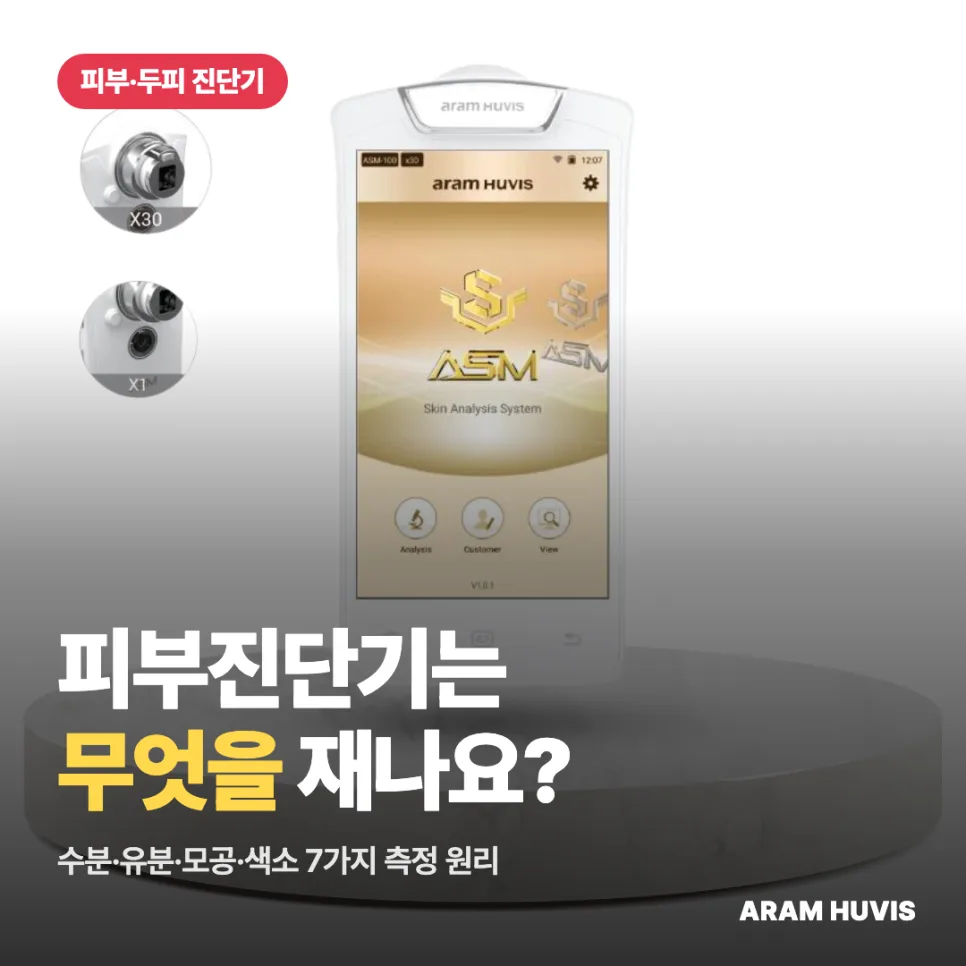
What does a skin analyzer measure? A skin analyzer reads seven things: moisture and elasticity, sebum (oil), pores, melanin (pigment), acne, wrinkles and sensitivity. Moisture is read by a sensor placed directly on the skin, while the rest come from photos magnified 30× under four kinds of light and shown as numbers compared against an average.
Because it reads both the photographed skin and the sensor value, two faces that look identical to the naked eye are separated by the numbers.
Below we go through what it measures, how moisture and oil are read, which lights reveal pores and pigment, and how to read the result so you can trust it.
What does a skin analyzer measure?
The ARAM HUVIS skin analyzers ASM 100 and APM PRO 100 report seven items: moisture and elasticity, sebum (U-zone / T-zone), pores, melanin, acne, wrinkles and sensitivity. A single measurement shows these items together.
Here, melanin is a number for how much pigment is present — it does not name a condition such as a freckle or a mole. The device measures and records; naming is the work of a dermatologist.
How are moisture and oil measured?
Moisture and oil are not read from a photo; they are measured in a different way.
For moisture, a sensor is held against the skin for three to four seconds to read the water held in the stratum corneum. Rather than guessing from shine in a photo, a sensor touching the skin produces the value.
Oil (sebum) uses an oil-absorbing paper. A strip is pressed to the forehead and nose (T-zone) and to the cheek and chin (U-zone), then lifted and photographed, and the amount of oil picked up is read. That is why the same person can show different sebum values on the forehead and the cheek.
These two values matter because some skin is oily on the surface yet dry underneath. Only by measuring moisture and oil separately can you tell apart patterns such as “oily on top, dry inside.”
By what principle are pores, pigment and wrinkles seen?
Pores, melanin, acne and wrinkles are read from magnified photos taken with a 30× lens. The key point is that the same spot is photographed under different lights.
The skin lenses on the ASM 100 and APM PRO 100 use four kinds of light: normal, polarized, UV and white. Light returning from skin is a mix of reflection bouncing off the surface and light scattered back from within the skin. Depending on which you capture, the same skin is photographed differently.
Polarized light filters out surface reflection — the same principle as the polarized sunglasses that cut glare off water.
- Normal and white light: skin texture and pores, the surface state
- Polarized light: pigment and redness, with surface reflection removed
- UV light: areas of deeper pigment and hidden features
Check which light a photo was taken under first. If texture looks smooth in a polarized photo, the skin may not have changed — the light may simply have removed the texture.
How do you read the result sheet?
For each item, the result screen shows the peer Average and your own value (Customer) as side-by-side bars. You can compare at a glance whether moisture is above or below average and in which zone sebum is higher. Below the value sits a one-line note such as “moisture is sufficient, but steady care is needed.”
These numbers are a record of the day’s state, not a fixed score. In a consultation it is common to view the average bar and your value together on one screen with the customer, and to write one action for today and the date of the next measurement at the bottom of the sheet.
A measured value is a tool for recording and comparing skin condition. It is not a device that diagnoses disease, and naming a spot or redness is the work of a dermatology visit.
What has to be kept the same to trust the values?
Even the same skin gives different values depending on how long it has been since cleansing, the room’s temperature and humidity, and the product applied just before. So the analyzer fixes the conditions of the shot first. The 30× lens sits against the skin so the distance is the same every time, and an LED light on the lens provides the lighting. Each photo is then set beside good, normal and poor reference images for comparison.
There are things the person has to keep the same, too: take the photo after makeup is removed and the skin is cleansed, once the same amount of time has passed, on the same spot and under the same light. On the sheet, leave six fields — date and time, time since cleansing, room temperature and humidity, the area measured, the product applied just before, and who measured — and match all six to the first time when you measure again. At the start, photograph the same spot twice on the same day to see how much the reading moves, and treat only a larger difference than that as a real change.
FAQ
Q. How is a skin analyzer different from a skin-check app? An app photographs the whole face at arm’s length under room lighting and estimates; the analyzer holds a lens against the skin and takes a large photo of one area under the device’s own light. Values that are hard to read from a photo, such as moisture, are measured directly with a sensor.
Q. Why is the moisture value different every time I measure? Because the water in the stratum corneum changes depending on whether you have just cleansed and how dry the room is. You have to measure at the same time and on the same spot for the values to be comparable.
Q. Does a high melanin value mean a freckle? No. It only shows how much pigment is present as a number. A condition name is confirmed by a dermatology visit.
Q. Why are the U-zone and T-zone measured separately? The forehead and nose (T-zone) often have more sebum while the cheek (U-zone) is often dry, so combining them into one value would differ from reality.
Q. How much does a skin analyzer cost? It varies with the measurement method, lens set, software and service coverage, so we guide pricing by configuration in a consultation. We recommend trying a measurement yourself in a demo before deciding.
Q. What is needed to introduce one in a store? The ASM 100 or APM PRO 100 unit and its app are enough to start measuring. The measured items and lens sets are shown on our website.
In summary
A skin analyzer reads seven items — moisture and elasticity, sebum, pores, melanin, acne, wrinkles and sensitivity. Moisture and oil are measured by sensor and oil-paper, while pores, pigment and wrinkles are read from 30× photos taken under normal, polarized, UV and white light. To read the values with confidence, fix the conditions of the shot and keep the six record fields the same each time. To ask about a device or a demo, see our contact page.
Measurements are for reference and do not replace medical diagnosis or treatment. ARAM HUVIS analyzers measure and display skin and scalp condition and do not diagnose or treat any disease. Cosmetics are not medicines for the prevention or treatment of disease.