AISG (AI-ScalpGrader): what it measures on the scalp and how it shows results
AISG photographs six areas of the scalp with a high-magnification camera, reads scalp condition, hair density and hair thickness, and an AI sorts the scalp into one of ten types. Results appear at once as per-area photos, a radial graph and values compared with a standard, and can be sent to a phone by QR code.
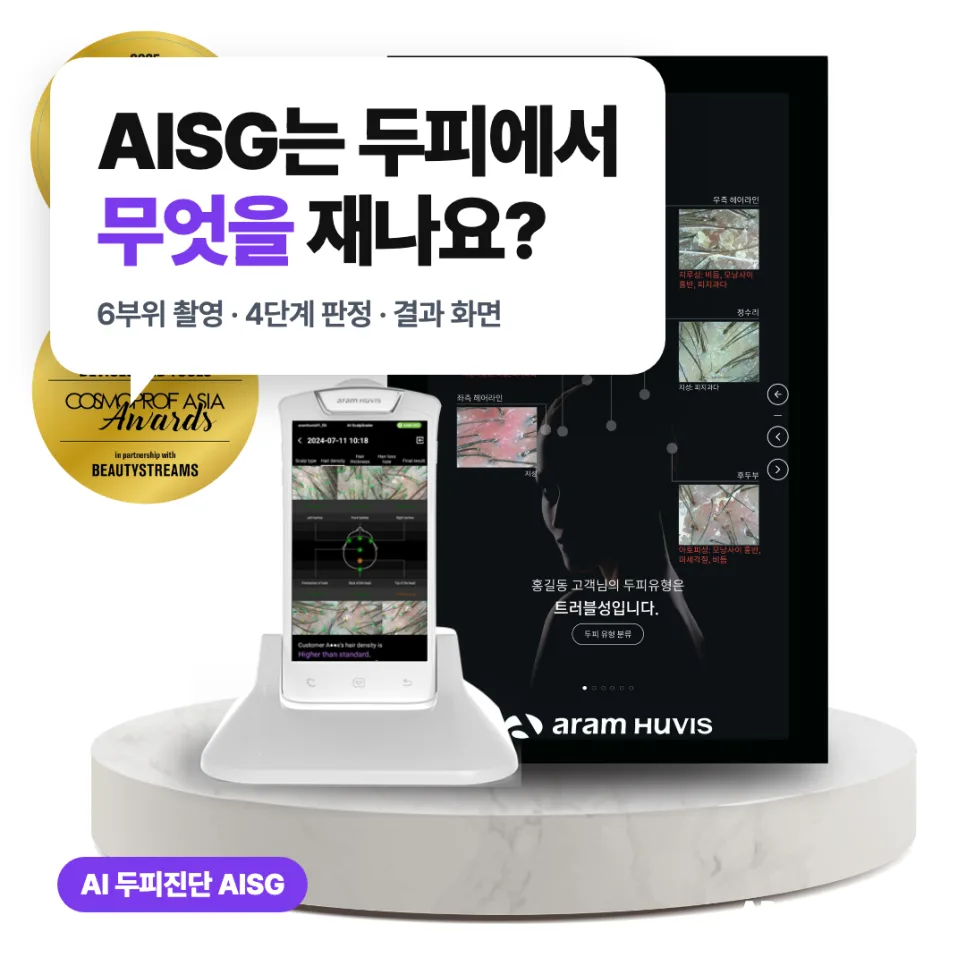
What does AISG measure, and how does it show results? AISG is ARAM HUVIS’s scalp-and-hair analysis system: a high-magnification camera photographs six areas of the scalp to read scalp condition, hair density and hair thickness, and an AI analyzes those photos to sort the scalp into one of ten types. The result appears on screen right away as per-area magnified photos, a radial graph, and density and thickness compared against a standard, and it can be sent to the customer’s phone by QR code.
The result then leads to a shampoo and scalp serum matched to that person.
Below we go through what it measures, how many steps it grades in, what the result sheet looks like, and the evidence and field use behind it.
What kind of device is AISG?
AISG is a system made of a handheld analyzer and a dedicated app. You place the lens at the tip of the analyzer against the scalp and take a magnified photo, and the app analyzes the photo with AI and shows the result.
The spec sheet lists a handheld analyzer (ASM-224S, with 60× and 500× lenses) and a 49-inch display (AMS-050) that shows the result on a large screen.
The AI was developed with the advice and validation of the dermatology department at Seoul National University Bundang Hospital. It was trained on 101,027 magnified scalp images, and this work was published in an international journal in 2024.
What, and where, does it measure on the scalp?
Measurement starts with customer registration. After entering name, date of birth, sex and contact details, plus skin type (the Fitzpatrick type graded by how the skin reacts to sun), you photograph six set areas in turn.
The six areas are the left hairline, the front hairline, the front center, the right hairline, the crown and the occiput (back of the head). When the last photo is taken, the AI analysis starts automatically.
Cuticle and color tone are optional items, so you can stop after the scalp measurement or continue to a hair and color consultation.
In how many steps, and by what standard, does it grade?
The basis of AISG grading is the SPI (Scalp Photographic Index), a scalp scoring system created by the dermatology department of Seoul National University Bundang Hospital. SPI rates five features in a magnified photo — dryness, oiliness, erythema (redness), pustules and dandruff — each on a 0–3, four-level scale. The reliability of this system was validated in a 2023 paper in the Journal of Dermatological Treatment.
The AISG AI learned from images that had been SPI-scored, with a model for each feature validated against dermatologist scoring.
Combining the per-feature results, the scalp is classified into ten types: normal, dry, oily, sensitive, seborrheic, atopic, trouble-prone, hair-loss, dry-dandruff and oily-dandruff. When several signs overlap, the type is decided by which to manage first — for example, when trouble-prone and atopic signs appear together, it is classified as trouble-prone.
These type names are names for a scalp condition, not a disease diagnosis. Even if a result reads “seborrheic” or “hair-loss,” it is not a diagnosis of a condition but a classification of what is visible in the photo.
How does the result sheet show it?
The first result screen shows the scalp type on a radial graph, together with hair density and thickness. Tapping each item brings up the photos and values for the six areas. For each area a state such as “excess sebum” or “inter-follicular redness” is written, and below it sits a one-line conclusion: “your scalp type is ○○.”
Menus for use right in the consultation are inside the result screen too:
- Compare with previous result: view the same customer’s past measurement next to the current one.
- Scalp care steps and method: show the care order and method that fit the classified type.
- Send by QR code: the customer scans the QR code with a phone to take the result away.
The overall result screen also shows an AI formula — a screen that proposes the ingredient makeup and ratios for a shampoo and scalp serum to match the classified type. From measurement to product runs in four steps: measure → AI scalp analysis → one-to-one custom formula → custom product made.
What is the evidence, the awards and the field use?
Clinical research — In a study by the dermatology department of Seoul National University Bundang Hospital, 100 adults used a shampoo and serum matched to their AISG analysis for four weeks. Scalp photographic index (SPI) scores fell by an average of 51%, and 93% of participants reported a change on at least one survey item (Journal of Dermatological Treatment, 2024). This was a before-and-after comparison without a control group, and it reflects the products matched to the reading, not the measuring device itself.
Use in other research — AISG has also been used as a standardized scalp-imaging device in other studies, such as a 2026 paper in Dermatologic Therapy. That means the device was used for measurement; it does not mean a product result.
Awards — AI-ScalpGrader received a CES 2023 Innovation Award, and was recognized in the Home & Professional Devices & Tools category at Cosmoprof Asia 2024 and at Cosmoprof Bologna 2025.
Patents — The company holds patents for an AI scalp-image analysis system and a product-recommendation system (Patent No. 10-2271558) and for a scalp-type system based on scalp-condition information (Patent No. 10-2398034).
Field use — According to reports in May 2025, AISG was introduced at clinics in the Seoul metropolitan area. In June 2025, ARAM HUVIS’s custom scalp-care brand Lilai (lilai.ai) began an AI custom shampoo-and-serum service for general customers at the Chicor Gangnam store.
FAQ
Q. What do I need for a single AISG measurement? The basics are the handheld analyzer with the AISG app. You register the customer’s details, photograph the six areas, and the analysis starts automatically.
Q. Can an AISG result diagnose hair loss? No. AISG measures and classifies scalp condition and suggests a care direction. A condition is diagnosed by a doctor’s examination.
Q. Can I track the same customer’s changes? Yes. Results are saved per customer, and the “compare with previous result” menu shows the past measurement next to the current one.
Q. How is the result given to the customer? The customer scans the QR code on the result screen with a phone to take the result away. With the 49-inch display, you can also view it together on a large screen during the consultation.
Q. Do I have to use the custom shampoo and serum as well? Whether recommended products appear on the result screen is set in the app (recommendation solution). How the custom products connect is decided together at the introduction consultation.
Q. How much does AISG cost? It varies by configuration — whether you use only the handheld analyzer, or add the large display and the custom-product link — so we guide pricing at the introduction consultation.
Q. Can an individual get an AISG measurement? Since June 2025, general customers can be measured through the Lilai AI custom shampoo-and-serum service at the Chicor Gangnam store. For the nearest measurement location, please ask us through our contact details.
In summary
AISG photographs six areas of the scalp, reads scalp condition, hair density and hair thickness, and an AI sorts the scalp into one of ten types based on the hospital-made SPI scoring system. The result sheet shows a radial graph, per-area photos and a care direction, and connects to a custom shampoo and serum. To ask about introducing a device or a demo, see our contact page.
Measurements are for reference and do not replace medical diagnosis or treatment. ARAM HUVIS analyzers measure and display skin and scalp condition and do not diagnose or treat any disease. Cosmetics are not medicines for the prevention or treatment of disease.