How Do You Explain Skin Analysis Results to Clients? A 4-Step Order and Sample Scripts
Explain skin analysis results in a fixed order: what looks good, what to watch, one thing to do today, and the next re-measurement. Describe numbers by their position against the average and with the magnified photo, and refer medical signs to a dermatologist.

When you turn the screen toward a client after a skin analysis, their eyes tend to go straight to the lowest number. A results consultation is not time to read out every number. It is time to say four things in a set order.
Short answer
- Run the consultation in this order: what looks good, what to watch, one thing to do today, then the next re-measurement.
- Describe numbers by their position against the average and with the magnified photo, and replace words like “bad” with “an item we will look after together today.”
- For signs that need a medical judgment, such as oozing, pain, or spreading redness, refer the client to a dermatologist instead of measuring.

What are the four steps of a skin analysis consultation?
Explain the report in this order: what looks good, what to watch, one thing to do today, and the next re-measurement. A fixed order means the client hears the same story whether the owner is busy or a manager takes over.
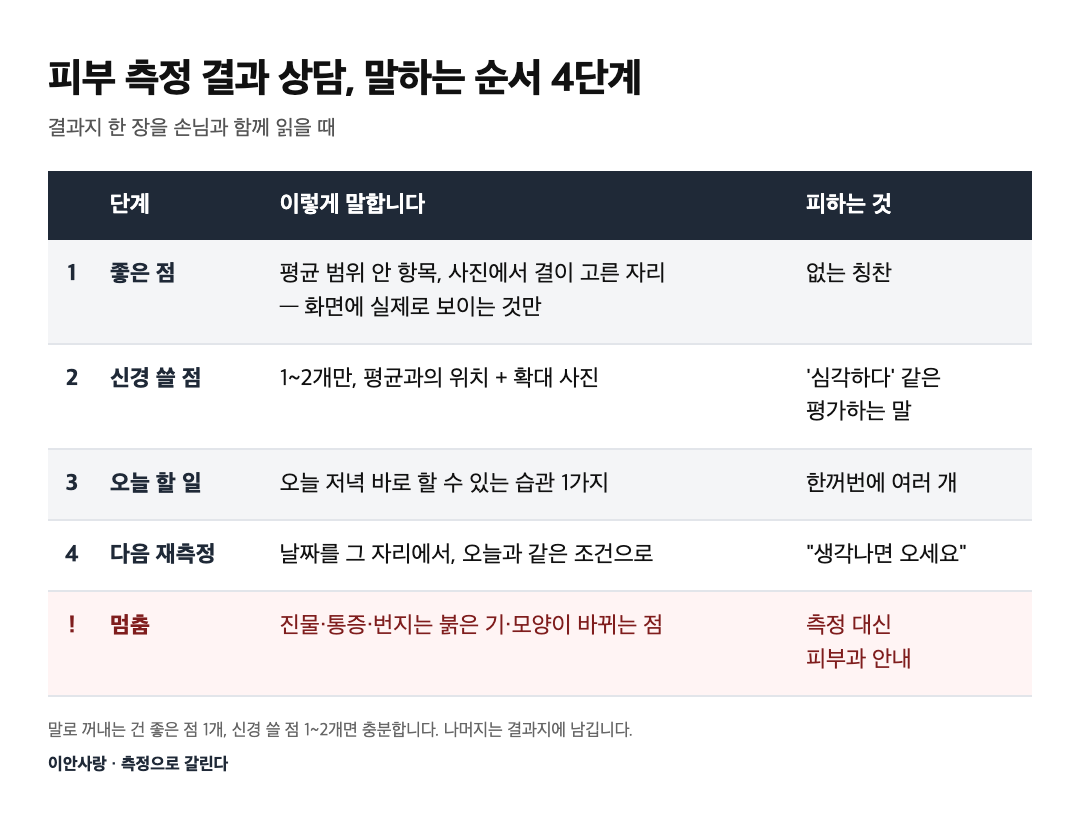
| Step | How to say it | What to avoid |
|---|---|---|
| 1. What looks good | Items within the average range, or areas where the texture looks even in the photo. Only what actually appears on the screen | Praise that is not there |
| 2. What to watch | Only 1 to 2 items, with position against the average plus the magnified photo | Judging words such as “serious” |
| 3. What to do today | One habit the client can start this evening | Several at once |
| 4. Next re-measurement | Set the date on the spot, under the same conditions as today | “Come back when you think of it” |
| ! Stop | Oozing, pain, spreading redness, or a mole that changes shape | Refer to a dermatologist instead of measuring |
The four steps do not need to be long. Even with many measured items, one good point and one or two items to watch are plenty. The rest is on the report, and you can point it out if the client asks.
Why start with a good point?
When the first thing a client hears is a good point, they are more likely to take the screen as a record of their own skin and not as a report card. So start with an item inside the average range or one that is better than last time.
Do not invent good points. Mention only what you can actually see on screen, such as a value inside the average range or an area where the magnified photo shows even texture. Praise that is not there costs you trust on the next measurement day.
How should you talk about the numbers?
Talk about numbers as a position, not a verdict. “Hydration is a little below the average line” delivers the same fact as “hydration is low” with less alarm.

Do not just read numbers. Point at the magnified photo too, so the client can follow what they are looking at.
Agree on words to avoid in your salon. Instead of “serious,” “bad,” or “your skin looks old,” which judge the person, say “an item we will look after together today.” If the screen shows grades or stars, show the original value and the photo before the grade.
Also avoid labeling a skin type from a single reading. Time since cleansing, room temperature and humidity, and the product applied just before can all change the value on the same skin.
What conditions should you record on the report?
To say “it is better than last time” later, the first report must show the conditions it was measured under. If conditions differ, you cannot tell whether a difference came from the skin or from the environment.
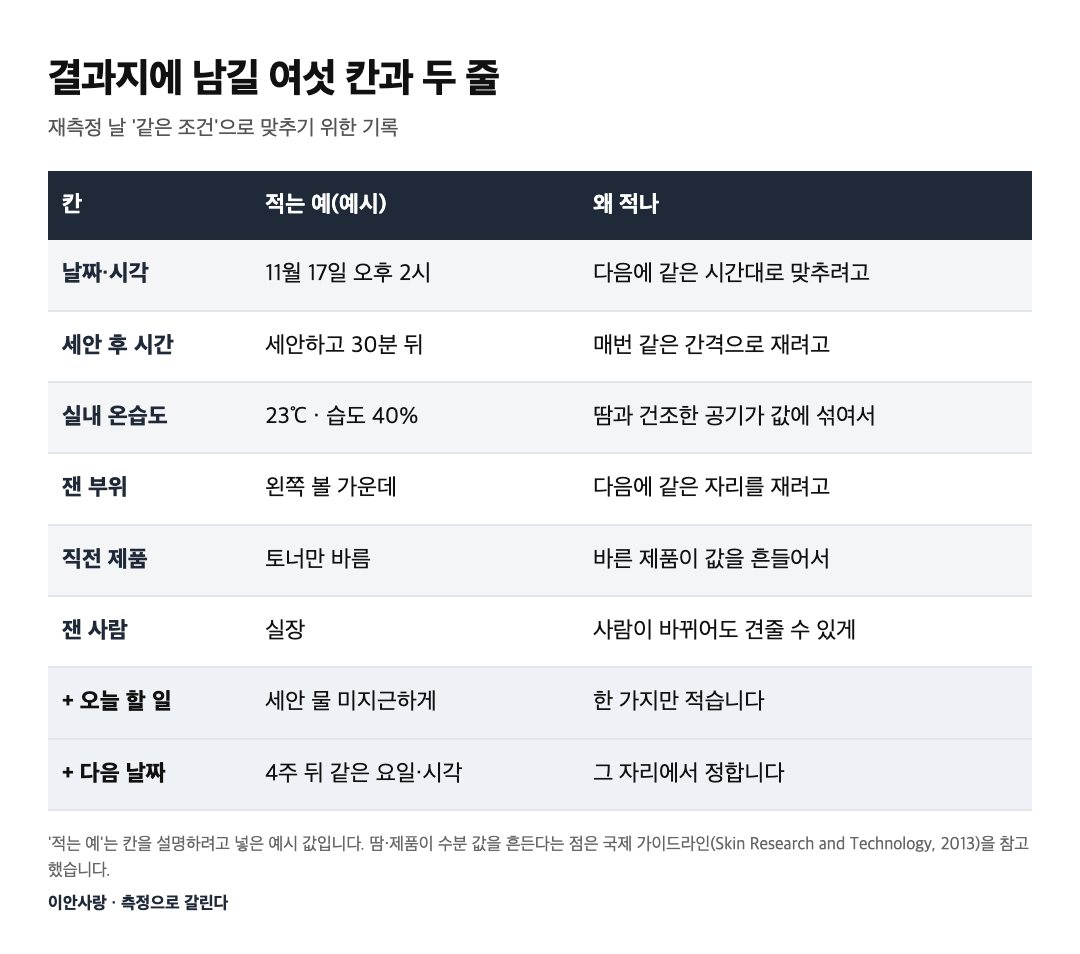
| Field | Example (illustrative) | Why record it |
|---|---|---|
| Date and time | Nov 17, 2 p.m. | To match the same time of day next time |
| Time since cleansing | 30 minutes after cleansing | To measure at the same interval every time |
| Room temperature and humidity | 23°C, 40% humidity | Sweat and dry air mix into the value |
| Measured area | Center of the left cheek | To measure the same spot next time |
| Product applied just before | Toner only | The applied product shifts the value |
| Measured by | Manager | So results can be compared even if the person changes |
| + One thing to do today | Use lukewarm water to cleanse | Write only one thing |
| + Next date | 4 weeks later, same day of the week and time | Decide on the spot |
The “example” column holds illustrative values to explain each field. The point that sweat and products affect hydration values draws on an international guideline (Skin Research and Technology, 2013).
Six fields are enough: date and time, time since cleansing, room temperature and humidity, measured area, product applied just before, and who measured. On re-measurement day, match all six to the first visit before comparing numbers.

Under the report, write one thing to do today and the next re-measurement date. The task should be something the client can do this evening, such as switching to lukewarm water for cleansing.

Set the re-measurement date on the spot. Choosing the same day of the week and time of day makes it easier to match conditions.
What does a skin analysis consultation script sound like?
The lines below are examples made to show the order. They are not real conversations with clients, so adapt them to your salon’s voice.
- What looks good: “Your sebum is within the average range. You can keep doing what you are doing.”
- What to watch: “Hydration is a little below the average line. You can see in the photo that the texture is slightly raised.”
- What to do today: “Starting this evening, just switch your cleansing water to lukewarm. Only that one thing.”
- Next re-measurement: “In four weeks, at the same time of day, I will measure the same spot again and put it next to today’s value.”
Do not close with “Does that make sense?” Instead, ask in the client’s own words: “What will you change first when you get home?”
Yes-or-no questions such as “Do you understand?” are not check questions. People tend to answer “yes” whether they understood or not. — Agency for Healthcare Research and Quality (AHRQ), 2024
This is AHRQ’s teach-back guidance, written for clinical settings. It is a method in which the listener restates what they heard in their own words, and the guidance describes it as checking the explainer, not testing the listener. It is written for clinics but carries over to report consultations.
When should you hand a client off to a medical professional?
A measurement screen never names a disease. If any of the signs below appear, recommend a dermatologist first instead of recommending care that day.

- A spot with oozing or crusting, or that hurts when touched
- Redness that is spreading or comes with warmth
- Itching that has lasted several weeks
- A mole that is new or changing in shape or color
- The client is already seeing a dermatologist or uses a prescribed topical medicine
Write these criteria on your consultation sheet in advance, so whoever handles the client stops at the same place. You can tell the client the scope plainly: “Measurement is a tool for checking skin condition, so a dermatologist should look at this part first.”
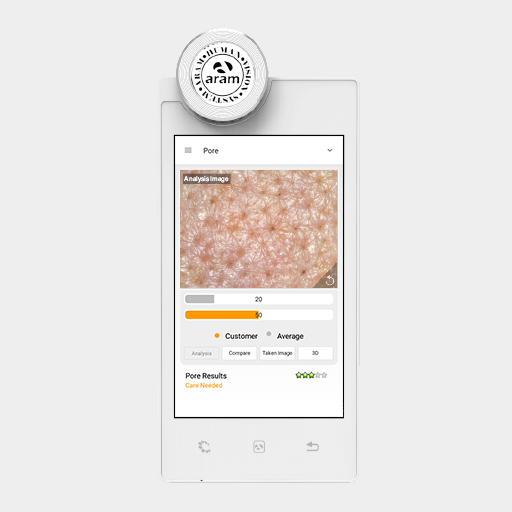
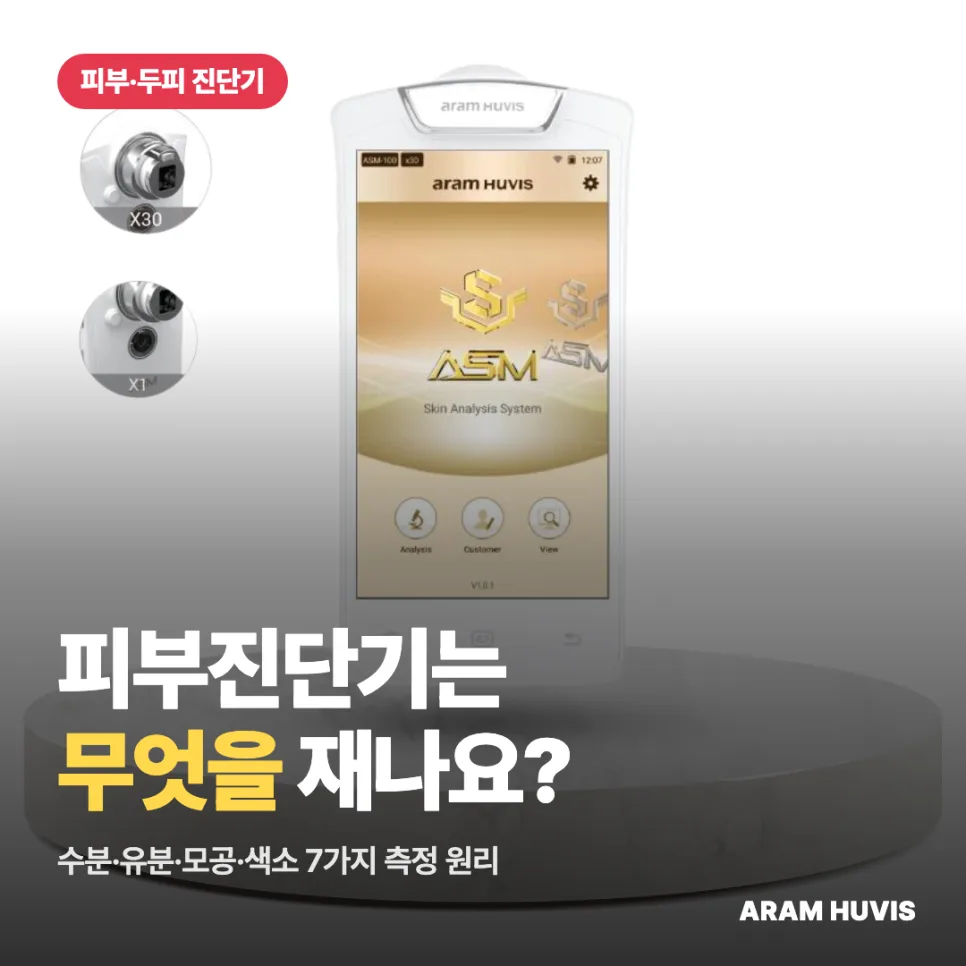
On our skin analyzers, such as ASM 100 and APM PRO 100, the result screen shows the client’s value and the average value as bars side by side under the magnified photo. The summary screen shows the measurement date with an explanation for each item. Screens can be mirrored to a large display so you and the client look at them together.
About ARAM HUVIS
Since 2002, ARAM HUVIS (아람휴비스) has built skin and scalp analyzers. Its skin analyzers include ASM 100 and APM PRO 100; see the ASM page or contact us to discuss adoption.
Skin analysis consultation FAQ
Q. What do I say first when every result is below average?
Start with the even areas in the magnified photo, or with the fact that today gives you a baseline to compare against. Pick only one of the items to watch.
Q. Should I give the report to the client?
It is better to. It becomes comparison material on re-measurement day only if it is a single page that shows the measurement conditions, today’s task, and the next date.
Q. Can the consultation script differ from staff member to staff member?
The tone can differ. Set the order, the words to avoid, and the criteria for referring to a dermatologist once for the whole salon.
Summary
- Run the consultation in this order: what looks good, what to watch, one thing to do today, next re-measurement.
- Describe numbers by position against the average, together with the magnified photo.
- Record six condition fields and the next date on the report so re-measurement day can be compared.
- Refer oozing, pain, spreading redness, or changing moles to a dermatologist instead of measuring.
Measurements are for reference and do not replace medical diagnosis or treatment.
Related reading
- Can you trust an AI skin analysis score? Phone app vs. dedicated analyzer
- Hair density per cm2: how to read the numbers
References
- Agency for Healthcare Research and Quality (AHRQ), Health Literacy Universal Precautions Toolkit — Tool 5: Use the Teach-Back Method, 2024 — ahrq.gov
- du Plessis J et al., International guidelines for the in vivo assessment of skin properties in non-clinical settings: Part 2, Skin Research and Technology, 2013 — PMC
- ARAM HUVIS, ASM and APM PRO product information — aramhuvis.com
ARAM HUVIS analyzers measure and display skin and scalp conditions. They do not diagnose or treat any disease. Cosmetics are not drugs for the prevention or treatment of disease.