Can You Trust an AI Skin Analysis Score? Phone App vs. Dedicated Skin Analyzer
An AI skin analysis score is an estimate made from a single photo, so check the lighting and distance of that photo before you trust the number. Compare only scores taken under the same light, at the same distance, and treat them as reference, not diagnosis.

You scan your face with a skin analysis app before bed and the pore score is lower than yesterday. Did your skin really change overnight? An AI skin analysis estimates skin features from a single photo, so the first thing to check is the light and distance of that photo, not the score.
Short answer
- AI skin analysis compares the wrinkle, pore, and pigment signals in a photo with graded reference images and turns them into a score. It is an estimate.
- A phone app shoots under whatever room light and arm’s-length distance you happen to have. A dedicated skin analyzer presses the lens against the skin and shoots under its own built-in light.
- Compare only scores taken under the same light and distance, and never treat them as a diagnosis.
What does an AI skin analysis actually do?
It finds areas of the face in a photo, compares signals such as wrinkles, pores, and pigment with pre-trained grades, and assigns scores. It does not measure the skin directly. It reads a photo and estimates.
A 2019 study in the International Journal of Cosmetic Science, by researchers from a developer company, trained a neural network on a skin aging atlas (a graded photo collection) and scored nine facial signs in selfies.
So an AI skin score answers the question “which graded photo does this picture look closest to?” Change the light and the same face becomes a different photo.
What can a photo capture, and what can’t it?
Things you can see, such as wrinkles, pores, pigment, redness, and shine, can be read from a photo. Values you cannot see, such as the water held in the stratum corneum, are hard to measure from a photo alone.
Our own skin analyzer manuals show how this works in practice: hydration is read by pressing a sensor against the skin for 3 to 4 seconds, and oil is read by pressing oil-blotting paper on the T-zone and U-zone and photographing it.

If an app shows a hydration score, ask how that value was produced. It may be an estimate based on shine or texture in the photo.
How is a phone app different from a dedicated skin analyzer?
The biggest difference is the shooting condition. An app photographs the whole face under room light at arm’s length. A dedicated analyzer presses the lens to the skin and photographs one area, enlarged, under the device’s own light.
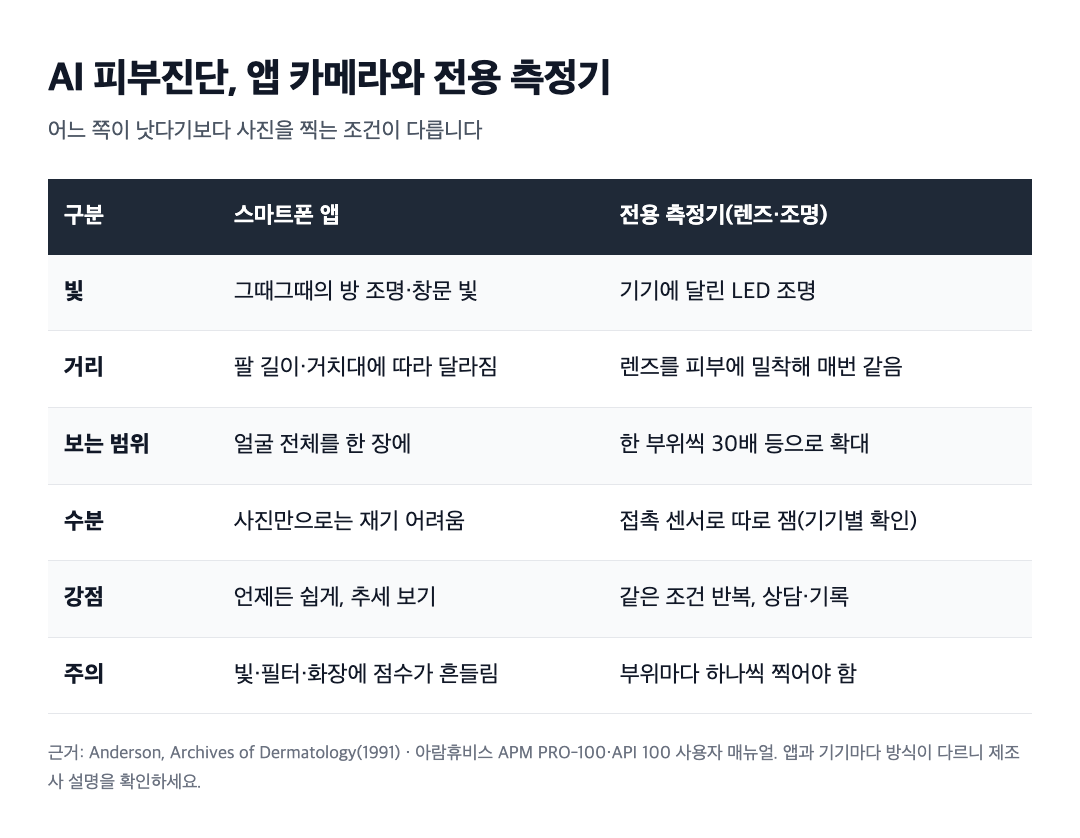
| Item | Smartphone app | Dedicated analyzer (lens and lighting) |
|---|---|---|
| Light | Whatever room or window light there is | Built-in LED lighting |
| Distance | Varies with arm length or stand | Lens touches the skin, so it is the same every time |
| Field of view | Whole face in one shot | One area at a time, magnified (for example 30x) |
| Hydration | Hard to measure from a photo alone | Measured separately by a contact sensor (varies by device) |
| Strength | Easy anytime, good for seeing trends | Repeats the same conditions, good for consultation and records |
| Caution | Score shifts with light, filters, and makeup | Each area must be shot one at a time |
Source: Anderson, Archives of Dermatology (1991); ARAM HUVIS APM PRO-100 and API 100 user manuals. Apps and devices differ, so check each maker’s description.
Light returning from skin is a mix of surface shine and light scattered from inside the skin. Which one the camera captures more of changes how the same skin looks.
With the polarizers parallel, the skin surface became sharper. With them crossed, surface texture and wrinkles disappeared while blood vessels and pigment became easier to see. — Archives of Dermatology, 1991
A Harvard Medical School team photographed 30 people to show this. Changing only how the light is received changes how wrinkles and pigment appear. That is why a window versus a bathroom can move an app’s score.
That does not make the dedicated analyzer the only answer. An app can photograph the whole face any time and show a trend. Whether it is a skin analyzer with AI or an app, results are comparable only under the same conditions.
What should you check before trusting the result?
Before reading an AI skin analysis score, check three things: light, distance, and repetition. If any one differs from last time, the score difference may come from the photo and not from the skin.
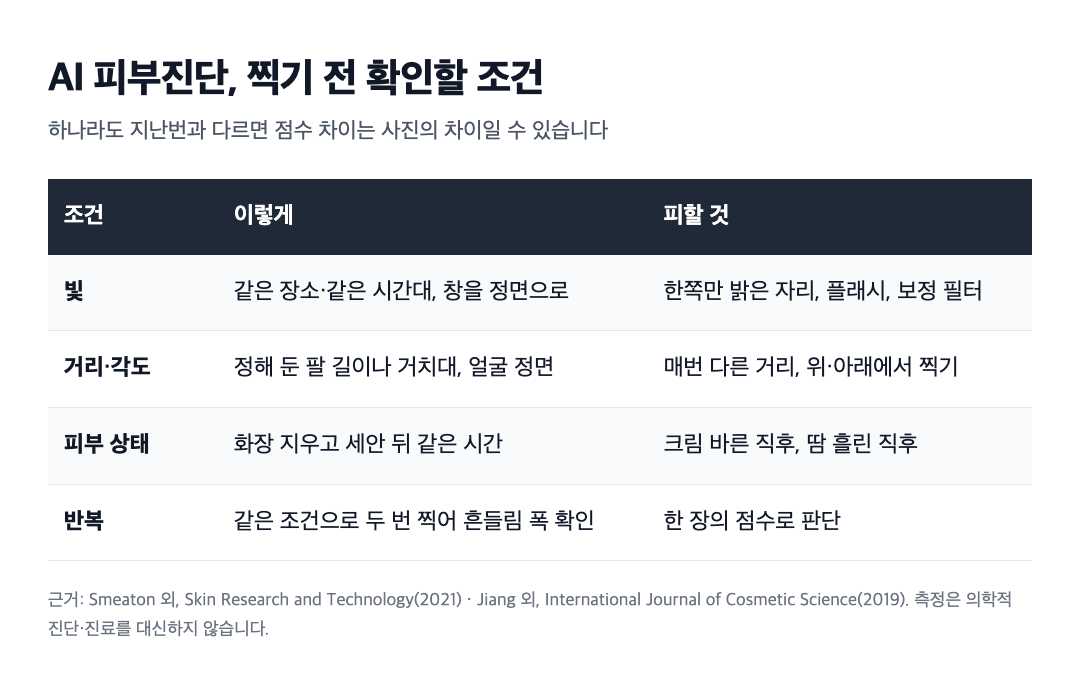
| Condition | Do this | Avoid |
|---|---|---|
| Light | Same place, same time of day, facing the window | Light on one side only, flash, beauty filters |
| Distance and angle | Fixed arm length or stand, face straight on | A different distance each time, shooting from above or below |
| Skin state | Makeup removed, same time after cleansing | Right after applying cream, right after sweating |
| Repetition | Shoot twice under the same conditions and check how much the score wobbles | Judging from a single photo’s score |
Source: Smeaton et al., Skin Research and Technology (2021); Jiang et al., International Journal of Cosmetic Science (2019). Measurements do not replace medical diagnosis or treatment.
Light. Face the window at the same place and time of day. Turn off the flash and any beauty filter. A 2021 study that tracked skin color from selfies also had to correct for lighting that changed each time, using a color card.
Distance and angle. Fix an arm length or a stand position and shoot from straight on. Remove makeup and shoot at the same time after cleansing.
Repetition. Shoot twice in a row under the same conditions and see how much the score moves. Do not read differences smaller than that as change.
What are the limits of an AI skin score?
Agreement varies by item. One study found that large structures such as wrinkles, nasolabial folds, and sagging matched well, while pores and pigment spots matched less well.
Five facial signs matched strongly with dermatologist assessment (r≥0.75), cheek pores matched moderately (0.63), and pigmentation matched weakly (0.40), especially on the darkest skin tones. — Journal of the European Academy of Dermatology and Venereology, 2023
In that study, AI and 50 dermatologists together graded selfies from 1,041 US women, each taken at home under light the participants chose. Researchers from the developer company took part.
A more important limit is that a score is not a diagnosis. A 2020 BMJ systematic review looked at nine studies covering six apps and concluded that algorithm-based apps cannot be relied on to find every skin cancer.
If a mole appears or changes shape or color, or redness, oozing, or itching continues, see a dermatologist before relying on an app score.
How does a dedicated skin analyzer take its photos?
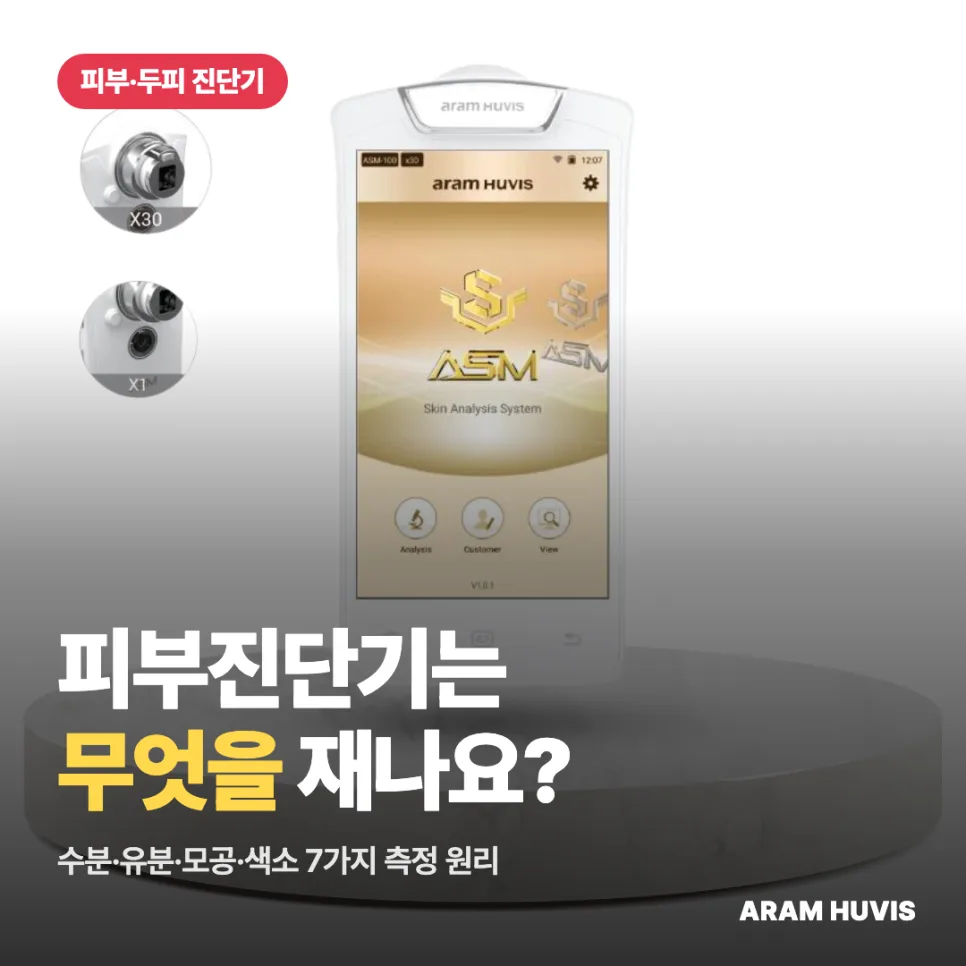
ARAM HUVIS (아람휴비스) has built skin and scalp analyzers since 2002. Its scalp analyzers AI-ScalpGrader and lilai View put AI analysis up front.

On the skin side, the shooting conditions are fixed first. A 30x lens presses against the skin, so distance is the same every time, and an LED light mounted with the lens provides the illumination. Each photo is compared side by side with good, average, and poor sample photos.
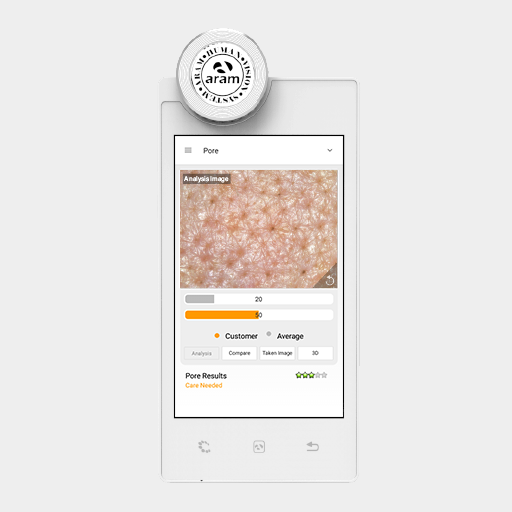
More important than the word “AI” is whether you can shoot the same spot next month with the same light and distance. That is what makes “compared with last time” possible, and it is what lets a client trust the score.
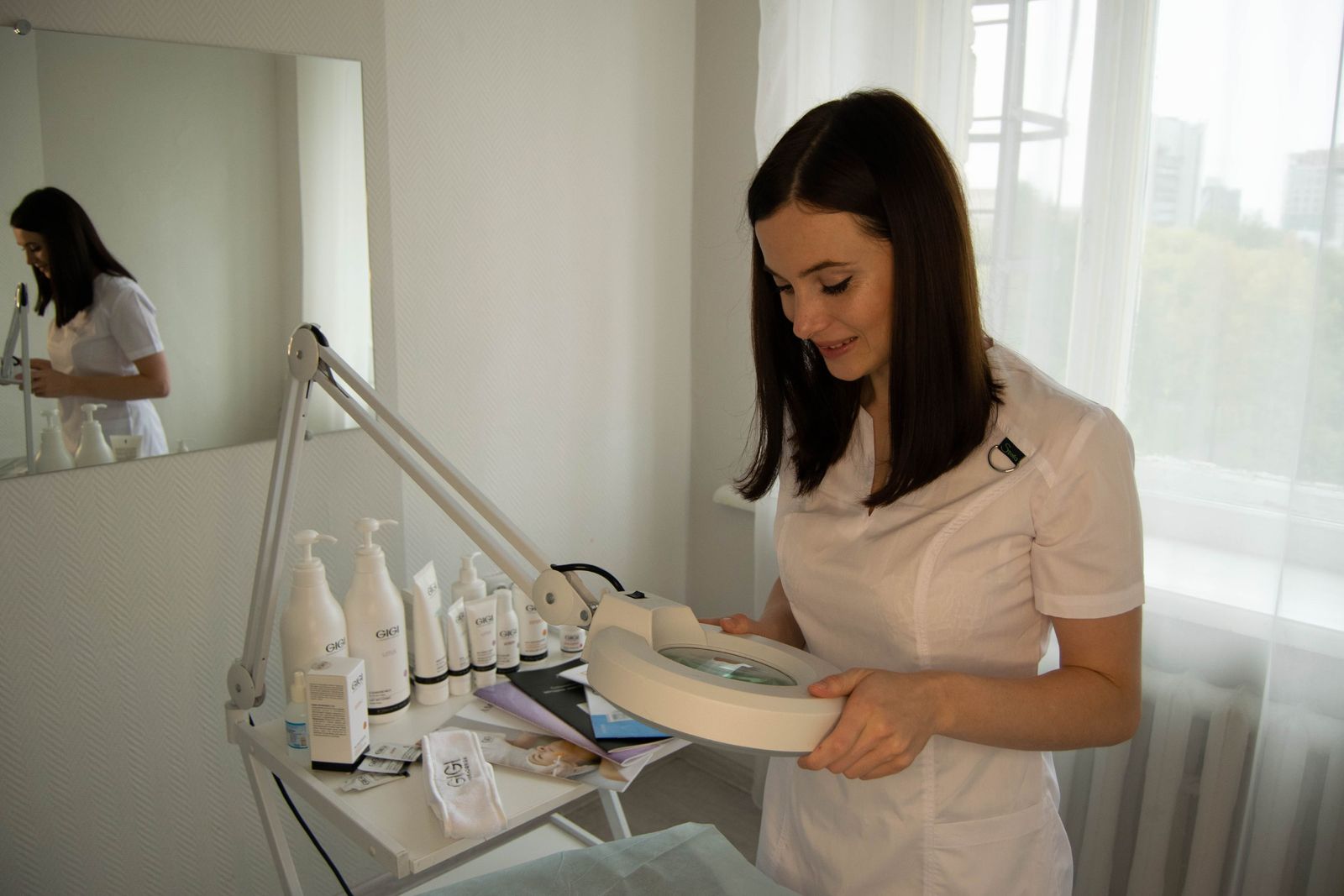
For salon owners looking for a skin analyzer, our ASM 100 and APM PRO 100 use a 30x lens to look at seven items: hydration and elasticity, sebum, pores, melanin, acne, wrinkles, and sensitivity. Results can be shared with clients through large-screen mirroring or email.
About ARAM HUVIS
Since 2002, ARAM HUVIS has built skin and scalp analyzers for salons, clinics, and distributors. See the ASM skin analyzer or contact us to discuss adoption.
AI skin analysis FAQ
Q. My AI skin analysis app gives different scores every day.
Light, distance, makeup, or time since cleansing has probably changed. Shoot twice under the same conditions and check the size of the wobble first.
Q. If the app and the salon analyzer disagree, which one is right?
They shoot differently and score on different scales, so the numbers cannot be compared with each other. Compare only changes measured by each one under its own repeated conditions.
Q. Can I judge my skin condition from an AI skin analysis result?
Use it only as a reference for choosing a care direction. For anything that worries you, such as a mole, a wound, or redness, get it checked by a doctor.
Summary
- AI skin analysis is an estimate that compares signals in a photo with graded references.
- Values that a photo cannot capture, such as hydration, need a separate way of measuring.
- The difference between an app and a dedicated analyzer is whether light and distance are fixed.
- Compare only scores from repeated shots under the same conditions, and never treat them as a diagnosis.
Measurements are for reference and do not replace medical diagnosis or treatment.
Related reading
- How to read a measurement report with a client
- Hair thickness tracking: scalp photos with the same spot, light, and interval
References
- Jiang R et al., Automatic grading of facial skin structural signs, International Journal of Cosmetic Science, 2019 — PubMed
- Flament F et al., Automated analysis of facial signs from selfie images of US women, JEADV, 2023 — PMC
- Anderson RR, Polarized light examination and photography of the skin, Archives of Dermatology, 1991 — PubMed
- Smeaton AF et al., Tracking skin color and wrinkle changes using smartphone images, Skin Research and Technology, 2021 — PubMed
- Freeman K et al., Algorithm based smartphone apps to assess risk of skin cancer, BMJ, 2020 — BMJ
- ARAM HUVIS, ASM, APM PRO, and AI-ScalpGrader product information and user manuals — aramhuvis.com
ARAM HUVIS analyzers measure and display skin and scalp conditions. They do not diagnose or treat any disease. Cosmetics are not drugs for the prevention or treatment of disease.